
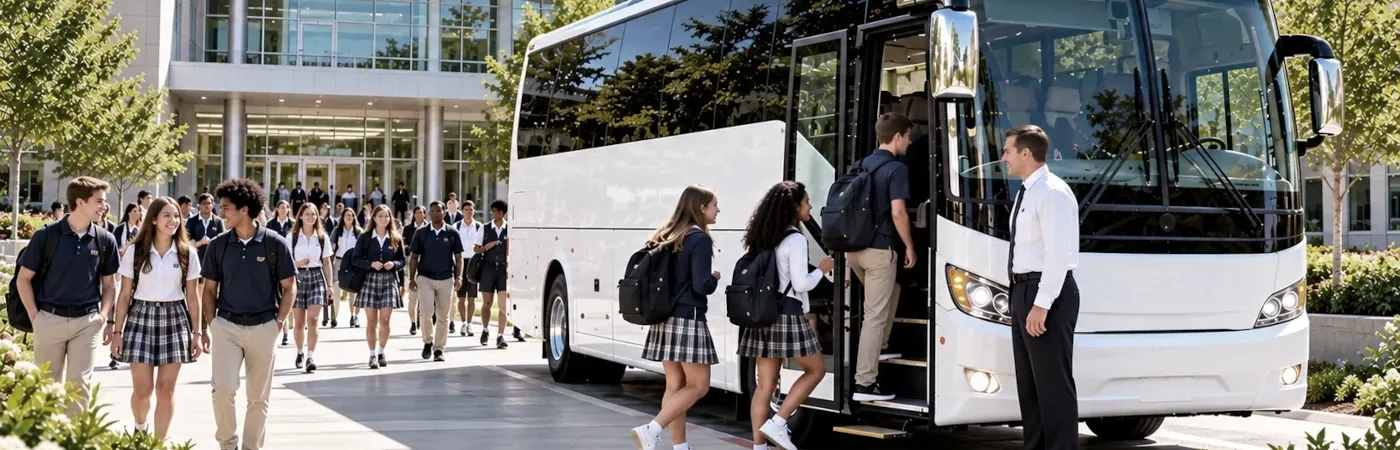
Charter Transportation for School & Student Groups
Schools use charter buses and other passenger vehicles for many kinds of group travel beyond the daily home-to-school route. Common trips include field trips, athletic competitions, academic events, performances, campus visits, educational tours and other school-sponsored activities.
The rules that apply can depend on the type of trip, the vehicle, who operates it, whether transportation crosses state lines and the laws of the state where service is provided. For that reason, a school transportation plan should begin with the trip itself rather than assuming that one state-specific designation applies everywhere.
TRIP PLANNING
Information to Provide When Requesting School Transportation
Give the transportation provider enough information to select an appropriate vehicle, plan the itinerary and identify any requirements that may apply to the trip.
Include:
- School or organization name and trip date
- Student grade or age group
- Total students, teachers and other adults
- Pickup and destination addresses
- Departure and return schedule
- All planned stops
- Whether the trip crosses state lines
- Accessibility requirements
- Equipment, instruments or storage needs
VEHICLE PLANNING
Match the Vehicle to the Group and Trip
Vehicle selection should account for passenger count, trip distance, luggage or equipment, accessibility needs and the school's own transportation policies. A short local outing may have different needs from an interstate athletic trip or a multi-day academic tour.
Passenger Count
Provide separate counts for students and accompanying adults so the group can be matched to suitable capacity.
Route & Distance
Share every stop, destination and state line crossing so the itinerary can be reviewed accurately.
Accessibility
Identify wheelchair-accessible transportation or other mobility needs when requesting service.
School Requirements
Tell the provider about district or institutional requirements for carrier documentation, insurance or approvals.
SCHOOL TRIP PLANNING
Requirements Can Vary by Trip and State
There is no single state-level pupil transportation rule that applies identically throughout the country. Federal motor-carrier requirements may apply to certain commercial passenger transportation in interstate commerce, while states and school districts may impose additional requirements for student transportation.
Schools should identify the nature of the trip clearly and confirm any required carrier credentials, insurance documentation, driver qualifications, vehicle requirements and internal approvals before service is finalized.
Federal rules distinguish among governmental school transportation, private-school transportation and transportation performed by contracted for-hire carriers. Applicability can also differ between regular home-to-school transportation and extracurricular trips. For unusual or interstate itineraries, current requirements should be confirmed for the specific operation.
COMMON QUESTIONS
School & Student Transportation FAQ
What should New York City schools consider when planning a charter trip?
Plan around the complete itinerary, passenger supervision, school or program requirements, accessibility needs, venue access, realistic travel time and safe pickup and drop-off arrangements.
What information should a school provide when requesting a charter?
Provide the school name, trip date, student age or grade group, passenger count, complete itinerary, all stops, accessibility needs, equipment or storage needs and whether the trip crosses state lines.
Are school field trips treated the same as daily school-bus routes?
Not necessarily. Federal rules distinguish regular home-to-school operations from some extracurricular and contracted transportation, and state requirements can also differ. The exact trip and operating arrangement matter.
What should we confirm before booking?
Confirm the itinerary, passenger count, vehicle needs and any school or district requirements for carrier credentials, insurance, driver qualifications, accessibility and approvals.
Should we allow extra time for New York City traffic?
Yes. Build realistic travel time into the itinerary and allow additional time for boarding, traffic, venue access and scheduled arrival requirements.
PLANNING SCHOOL OR STUDENT GROUP TRANSPORTATION?
Tell Us About the School Activity
Provide the school, trip date, passenger count, destinations and schedule so the transportation requirements can be reviewed as part of planning your trip.
New York Service • 24/7 Support